
Meet Leroy Laverman ‘99 (UCSB Ph.D. Chemistry): 25 Years of Dedication to UCSB Department of Chemistry and Biochemistry and College of Creative Studies
Laverman reflects on his path to UCSB, his role in growing the CCS chemistry and biochemistry major, and his service to campus
“What I find most meaningful about mentoring in CCS is the opportunity I have to see growth in students. It is quite unique to be able to stay in close contact with students from their first days on campus to when they graduate. Being able to share and, perhaps, play at least a minor role in their tremendous development is extremely rewarding.”
—Leroy Laverman, Teaching Professor, College of Creative Studies and UCSB Department of Chemistry and Biochemistry
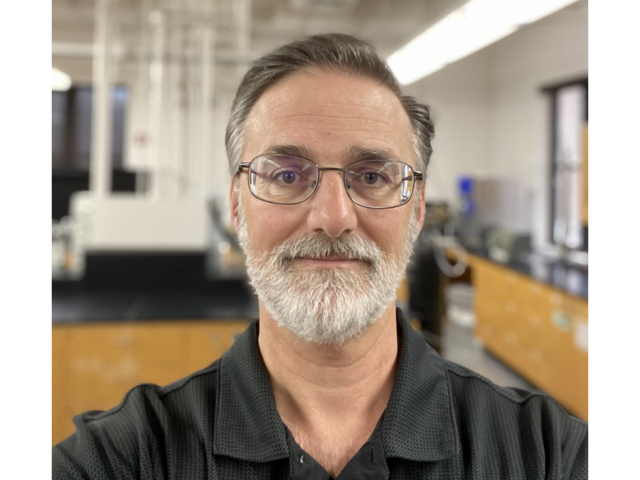
While destiny may have brought Leroy Laverman ‘99 (Ph.D. Chemistry)–Teaching Professor, College of Creative Studies and Department of Chemistry and Biochemistry at the University of California, Santa Barbara (UCSB)–to UCSB, his dedication to teaching and service with purpose has had a meaningful impact during his 25 years on campus. CCS recently sat down with Leroy to learn about his journey to UCSB, his role in growing the CCS chemistry and biochemistry major, and his service to campus.
During our discussion to create this story, Leroy shared three words to describe CCS. In the same manner he enthusiastically, carefully considered each of these, we can equally characterize Leroy:
- Boundless: Boundless enthusiasm. Boundless energy. Boundless curiosity.
- Driven: CCS students are often the most driven students I’ve come across. Not just in chemistry and biochemistry but frequently in multiple areas of pursuit.
- Stubborn: Not willing to accept the status quo. Navigating the curricular landscape in new and sometimes surprising ways.
For Leroy, “CCS students push the normal boundaries of the institution and of higher education. I see this in how students make their way through the curriculum. Despite having a fairly rigid curriculum, chemistry and biochemistry students like to make their own path–as well as students in other CCS majors.”
He reminds us to “Put away your studies or work and let yourself have a moment to do the things you love.”
Meet Leroy: Boundless. Driven. Not-willing-to-accept-the-status-quo.
The Journey to UCSB
Originally from the small rural agricultural community of Sunnyside in the state of Washington, Leroy Laverman ‘99 (Ph.D. Chemistry)–Teaching Professor, College of Creative Studies and Department of Chemistry and Biochemistry at the University of California, Santa Barbara (UCSB)–earned his undergraduate degree in chemistry at Washington State University (WSU). As an undergrad, he worked in a variety of research labs focused on inorganic chemistry, physical chemistry, analytical chemistry, and finally in biochemistry. His journey to pursue his passion for chemistry as a graduate student at UCSB stems from working on the synthesis of mixed metal polypyridyl complexes for potential applications in solar water splitting for production of hydrogen with then Assistant Professor of Chemistry Karen Brewer (now deceased) at Washington State University. That research led to Leroy’s passion for inorganic chemistry and eventually led him to UCSB to pursue his graduate work in chemistry.
Was Leroy’s journey from WSU to UCSB destined? It turns out that Leroy’s undergraduate advisor Professor Brewer had completed her Ph.D. at Clemson University working with distinguished inorganic chemist Professor John Peterson (now deceased) who had earned his Ph.D. at UCSB. Peterson’s Ph.D. research was under the tutelage of UCSB Department of Chemistry and Biochemistry Professor (now Emeritus) Peter C. Ford with whom Leroy completed his Ph.D. Destiny? For Leroy, “My path to UCSB may be seen as pre-determined, but my journey was partly due to dedicated faculty mentorship as an undergrad at WSU as well as at UCSB as a graduate student. In turn, I enjoy mentoring my students, seeing them grow, and celebrating their academic and professional achievements as alumni.”
“Leroy embodies so much of what makes CCS special. He brings his deep disciplinary expertise (having literally written the book on Chemistry Principles!) and is a tireless and effective mentor for our students. His impact extends far beyond the classroom or laboratory; through decades of leadership as Associate Dean and beyond, thoughtful and expert teaching, and unwavering support for students, Leroy has really helped shape the trajectory of the College itself. Generations of CCS students owe part of their growth and confidence as scientists and individuals to his steady guidance. We are very grateful for his work with us and proud to call him a colleague. Thank you, Leroy!”
—Timothy Sherwood, Dean, College of Creative Studies
Asked about his graduate work, Leroy recalls fondly, “My graduate thesis work with Professor Ford was on ligand substitution reaction mechanisms in metalloporphyrins, in particular with nitric oxide. Porphyrins are at the center of many proteins such as hemoglobin and myoglobin. The oxygenated porphyrin compounds give blood its deep red color and the nitrosylated compounds are the pink color of cured meats like ham and bacon. As an aside…and for curiosos…there really is no such thing as “uncured” bacon and ham. Cured meats use sodium nitrite as a preservative and the so-called uncured meats use extracts from plants like celery which naturally contain high levels of sodium nitrite. Because the plant extracts are not characterized by their chemical composition, producers can claim they are uncured.”
“I recall the vigor of our research group. Everyone challenged you to produce solid science. Group meetings were often difficult with everyone pointing out flaws in your results or conclusions. We had to learn to defend our results backed up by good evidence. It made us all better scientists.”
—Leroy Laverman, Teaching Professor, College of Creative Studies and UCSB Department of Chemistry and Biochemistry
While tedious at times, Leroy found his research quite fulfilling: “Ensuring reproducible results requires many hours and repeated experiments. I used to do a fair amount of research in the middle of the night so that I had the lab to myself. I was able to get a lot of results in these marathon all night lab sessions. I recall the vigor of our research group. Everyone challenged you to produce solid science. Group meetings were often difficult with everyone pointing out flaws in your results or conclusions. We had to learn to defend our results backed up by good evidence. It made us all better scientists.”
Teaching + Mentoring
Upon receiving his Ph.D. in 1999, Leroy became a lecturer in the UCSB Department of Chemistry and Biochemistry in 2000. Two years later in 2002, Leroy started teaching at the College of Creative Studies in a 50:50 split appointment. The CCS chemistry and biochemistry program included 6 students when Leroy started. Over the last 23 years teaching at CCS, he helped structure and grow the program to 55 students today.
"Leroy has always brought a sense of calmness and genuine care to all that he does. I can recall so many times when his mentorship resulted in a student finding their own path and in doing so, found their own sense of calm and purpose. In a lot of ways, Leroy embodies the ideal of "paying it forward," putting in tremendous time and effort as a mentor, teacher and a colleague, and this has helped shape CCS in so many positive ways. Many of his efforts in the growth and direction of CCS in his role as Associate Dean are behind the scenes, but very much appreciated."
—Kathy Foltz, CCS Biology Faculty and Professor Emeritus of Molecular, Cellular, and Developmental Biology (MCDB); and CCS Interim Dean (2016-2018)
Early on, he taught problem solving courses as a supplement to the honors chemistry series taught by the UCSB department of chemistry and biochemistry. For Leroy, he proudly recalls: “Over the years, this course has evolved into a separate general chemistry course for CCS students. I also started a course on research ethics many years ago and was later joined in teaching that course by CCS Biology Faculty (now Emerita) Claudia Tyler ‘91 ‘94 (UCSB M.A. Biology Ph.D. Biology). Lastly, I have occasionally offered a course on the applications of group theory to chemistry; while I enjoy teaching these courses most, it can be challenging to schedule them in an already compact teaching schedule. The CCS students enjoy these courses and that keeps me motivated to offer them. “What I find most meaningful about mentoring in CCS is the opportunity I have to see growth in students. It is quite unique to be able to stay in close contact with students from their first days on campus to when they graduate. Being able to share and, perhaps, play at least a minor role in their tremendous development is extremely rewarding.”
Research + Publishing
“I’ve really enjoyed being a student again and learning new things. I consider a day fulfilling if I learn at least one new thing.”
—Leroy Laverman, Teaching Professor, College of Creative Studies and UCSB Department of Chemistry and Biochemistry
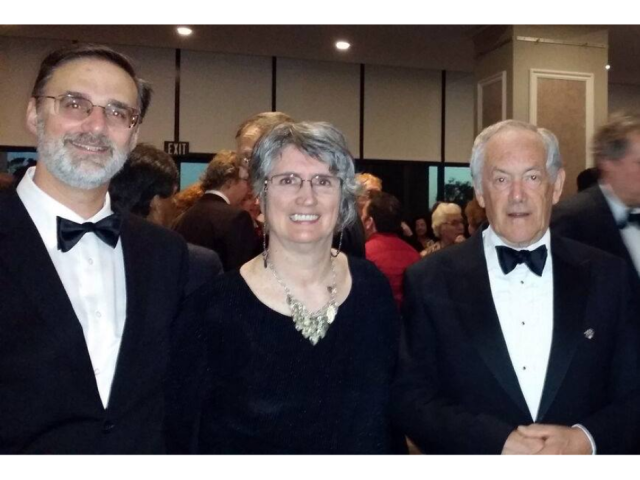
Leroy is currently engaged in research: “In the past year, I have started to learn how to do computational chemistry. Since then, I have collaborated with several of the inorganic chemists in our department of chemistry and biochemistry and performed density functional theory (DFT) calculations on systems that they are studying in their research groups. I’ve really enjoyed being a student again and learning new things. I consider a day fulfilling if I learn at least one new thing.”
In addition, Leroy has co-authored a general chemistry textbook, Chemical Principles: The Quest for Insight (6th edition, 2012; 7th edition, 2016; 8th edition, 2023) with Professor Loretta Jones (University of Northern Colorado) and Professor Peter Atkins (Oxford University) for the 6th and 7th editions. For the 8th edition, Professor James Patterson (Brigham Young University) and Associate Teaching Professor Kelley Young (Notre Dame University) joined the team as co-authors. We asked Leroy about the origins of the textbook: “My involvement in the book began with a phone call from the acquisitions editor at W.H.Freeman (now Macmillan Learning) around 2007. I was asked if I was willing to provide comments on drafts of the 5th edition of Chemical Principles that Peter and Loretta were working on. I agreed and they must have liked my feedback since they invited me to be a co-author starting with the 6th edition. I had no idea what I was in for. At the time, creating each new edition was an 18-24 month process. We generally write (and rewrite and rewrite…) during the first year, then begin working with the publisher on the final version, including copy editing and page proofing. The process has changed a bit with digital publishing becoming the new normal, but it still takes well over a year for a new edition.” The textbook has been used in college level chemistry courses all over the world. Various editions have been translated into multiple languages, including Spanish, Japanese, German, French, Portuguese, and Mandarin.
A Commitment to Service
“It has been rewarding to grow the CCS enrollment to roughly 5 to 6 times the number of [chemistry and biochemistry) students from when I began.”
—Leroy Laverman, Teaching Professor, College of Creative Studies and UCSB Department of Chemistry and Biochemistry
Over the years, Leroy has been key to the success of CCS administration. Early on at CCS, Leroy served as the chair of the CCS faculty executive committee in 2006-2011 and again in 2015-2016 with responsibility for running faculty meetings and coordinating CCS responses to UCSB academic senate business. He served as the CCS associate dean in 2016-2020 and again in 2022-2025, primarily overseeing the merits and promotions process for the faculty in the College. During the years 2019-2025, he served as the CCS associate dean faculty equity advisor. During these appointments, he also served on the CCS dean’s advisory council to provide guidance to the dean on college business.
In discussion with Leroy on his various roles, humbly, Leroy shared his thoughts on the impact he has had at CCS and campus: “First, the CCS chemistry and biochemistry major was listed as chemistry only when I began. The biochemistry major in the UCSB College of Letters & Science (L&S) was new (as was the department of chemistry and biochemistry, formerly the department of chemistry) and so we were able to add the biochemistry track, and the degree was changed to chemistry and biochemistry. At the same time, CCS did not have majors. There was a single major in the College called “creative studies.” CCS students would have an emphasis in a particular area, such as art or biology. As chair of the faculty executive committee, I was able to work with CCS leadership and the UCSB academic senate to have majors reinstated at CCS which is the current situation. This was concurrent with the degree name change to “chemistry and biochemistry” as well as creating the degree in “computer science” (now computing) which was not one of the original degrees offered at the College.”**
As mentioned earlier, the size of the CCS chemistry major was small, and Leroy was charged with increasing the number of CCS chemistry and biochemistry students: “It has been rewarding to grow the CCS enrollment to roughly 5 to 6 times the number of students from when I began. To further grow the program, if CCS sought that goal, an additional faculty member would be needed to assist with student advising and mentoring.”
Voiced Leroy, “Second, as associate dean, I have worked closely with our staff personnel analyst to define and refine our merits and promotions process. There have been several important changes in this process over the years, including the introduction of merit and promotion faculty meetings. I particularly enjoyed these meetings to see what amazing and wonderful things my colleagues have been doing in their classes across campus.”
Advice to Students and CCS
Leroy advises current and future students to:
- Follow their passion and be open to the possibility that what you truly love may change over time.
- Keep in mind there are so many things and ideas that you have not been exposed to yet.
- Explore random topics, take classes in areas you know nothing about. You just might find that your future is quite different from what you envision now.
The College is planning for its future to educate generations of artists, experts, academics, and leaders in their communities. As Leroy played a key role in advising CCS leadership over the years, we asked him how he sees the direction of higher education in 3, 5, 10+ years unfolding: “This is a challenging question as technology is advancing at a pace beyond our ability to keep up. In particular, student use of technology–such as AI and machine learning–is something that higher education is thinking hard about. In a world where answers to questions can be quickly (but often superficially) pulled up on a phone or computer, it’s hard to know if students are learning or simply parroting back. I think it’s important for us to teach students critical thinking and provide them with tools for sorting fact from fiction. An AI-generated response to a question may sound convincing but upon closer examination I’ve found facts are often wrong and misrepresented. It really is important to think for yourself and seek out primary trusted sources.”
Out + About
“For anyone reading this, I want to remind everyone to take time to enjoy the world around us. Put away your studies or work and let yourself have a moment to do the things you love. For myself, I enjoy cooking, baking and fishing. Take care of yourself and those around you and try to learn something new everyday.”
—Leroy Laverman, Teaching Professor, College of Creative Studies and UCSB Department of Chemistry and Biochemistry
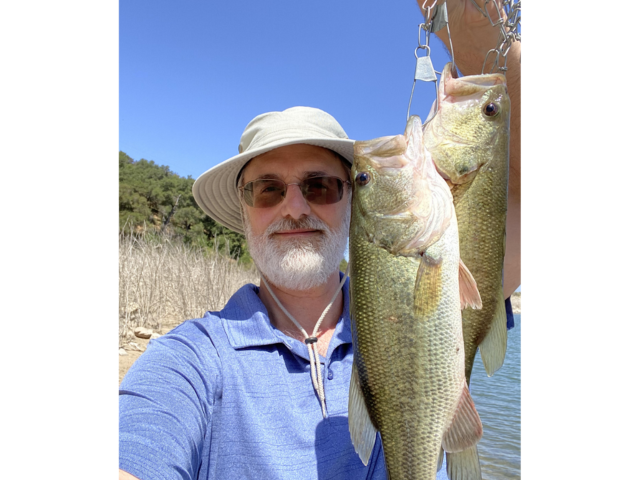
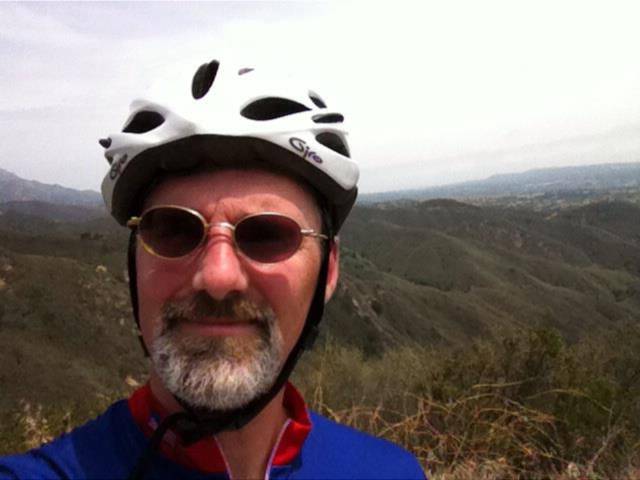
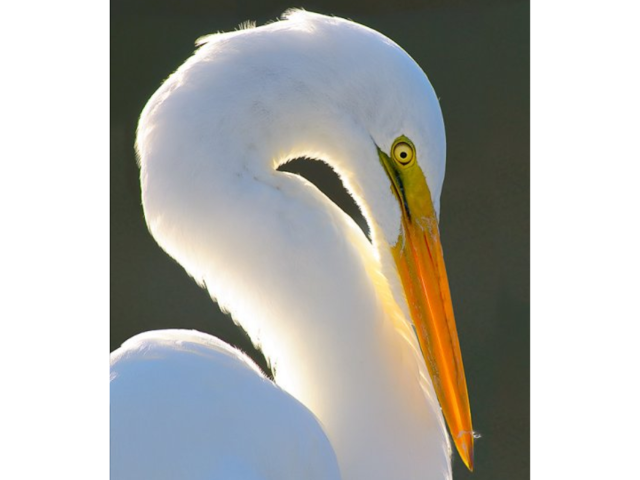
Photo 1: Leroy Laverman ‘99 (UCSB Ph.D. Chemistry) enjoys fishing at Cachuma Lake, 2025. Leroy’s pro tip: hold the fish close to the camera so it looks bigger.
Photo 2: Leroy Laverman ‘99 (UCSB Ph.D. Chemistry) biking (slowly) up old San Marcos pass, 2024.
Photo 3: Leroy Laverman ‘99 (UCSB Ph.D. Chemistry) enjoys photography. One of Leroy’s favorite photos he captured at the UCSB lagoon.
**Historically, CCS had different majors when the College was created, then it was changed to one degree (creative studies) with several emphases, then back to specific degrees.
Source of photos: Leroy Laverman