
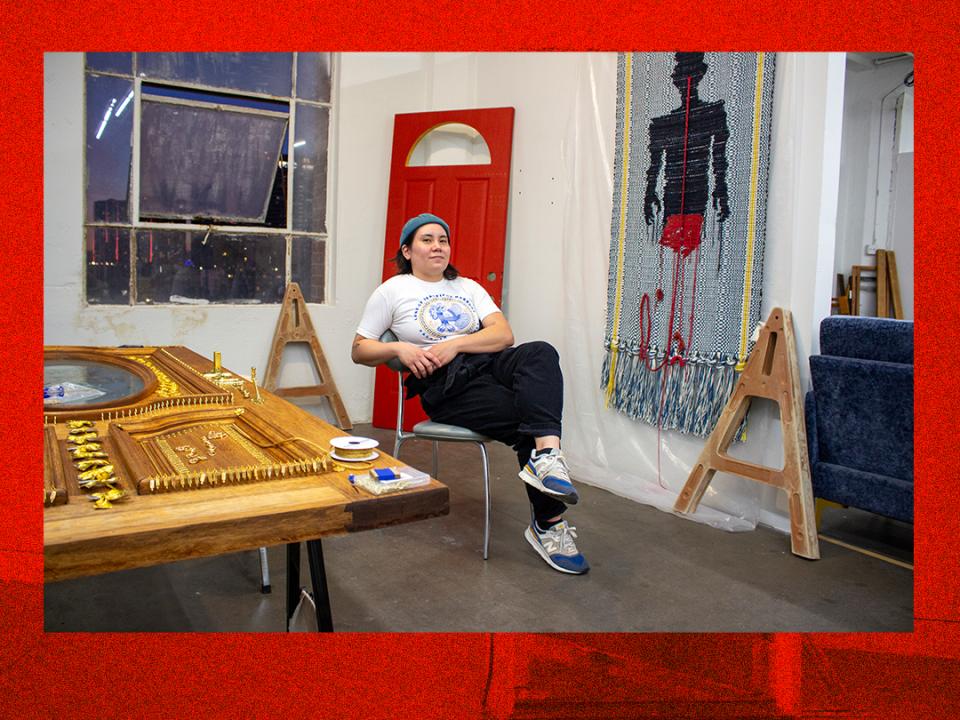
CCS Art Gallery Presents: Visiting Artist Lecture—Christine Hudson, "tabi-tabi po"
The College of Creative Studies Art Gallery is pleased to invite you to the soft opening of tabi-tabi po, a solo exhibition by Christine Hudson, on Wednesday, January 28, 2026.
We also warmly invite you to join us that same afternoon at 3:30 PM in the Old Little Theater for an artist talk, where Hudson will speak about their practice and the work currently on view in the gallery.
Faculty are encouraged to bring their classes or offer extra credit for student attendance.
“To be Filipino American is to be formed within this circulation rather than arrival. For the artist Christine Hudson, a second-generation Filipino American born into Orange County suburbia, this condition is not abstract but lived. Born American while origin remains elsewhere, born queer into a landscape that naturalizes heteronormative enclosure—each condition amplifies the other, where home is deferred and identity drawn from the same surface of displacement. To reach what empire has positioned beyond grasp requires a figure that can navigate what has been made illegible.
Hudson summons the aswang to rework what once signaled fear. In Filipino folklore, aswang refers to creatures shaped by proximity. They dwell among communities, pass as familiar, feed on blood, organs, breath, or unborn life. Harm arrives through intimacy. Their stories have circulated through colonial rule, famine, upheaval, giving form to violence that could not be openly addressed. Here, the aswang becomes not myth but recognition, identifying extraction embedded in everyday life and offering a method for return that refuses colonial terms of coherence. Bakunawa appears in this exhibition as one such figure, a sea dragon serpent driven by loss and longing who swallowed six moons and reaches still for the seventh. Each eclipse marks not catastrophe but hunger that cannot be satisfied, revenge that cannot be complete. Formed in suburbia where enclosure promised coherence while rendering the queer transnational body perpetually unhomed, Bakunawa's eclipse offers a model. Where queerness and Filipino diasporic identity must circulate without settling, made productive without arrival, fluidity becomes survival against empire's demand for fixed boundaries. Yet this fluidity itself demands examination. Hudson calls for eclipse as boundary, summoning shadow to measure the extent of interiority and exteriority, testing where one ends and the other begins. The aswang recasts itself as doors. “
Excerpt written by Christine Dianne Guiyangco (see full exhibition text in attached press release).
We hope you will join us for this special opening and conversation next Wednesday, January 28, 2026 at 3:30pm.